
Powering research to empower our grid
Monica Cooney
Nov 18, 2025
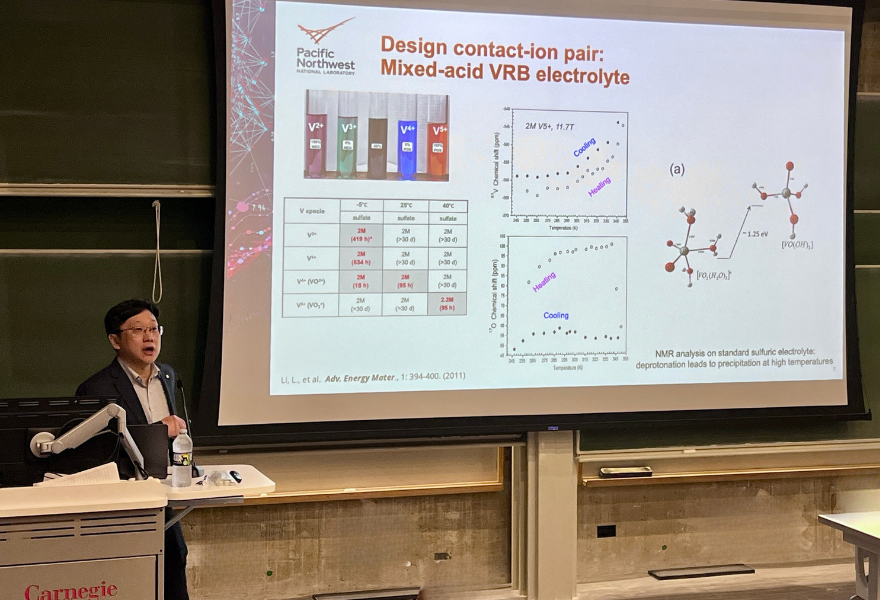
Wang delivered a graduate student seminar during the fall semester.
As energy demand continues to grow due to technological advancement, creating batteries that can better serve our nation’s grid is a crucial endeavor.
Wei Wang (Ph.D. ‘09), who is a Laboratory Fellow at Pacific Northwest National Laboratory (PNNL), is a key contributor in developing battery technologies that are safer, more cost-effective, and efficient for grid-scale energy storage applications.
“Our grid wants stability. The grid needs to have a certain amount of resilience and batteries play a big role in that,” Wang says.
He currently serves as the Deputy Director of the Energy Storage Research Alliance, an Energy Innovation Hub funded by the U.S. Department of Energy (DOE) that brings together national labs, industry, and academia to facilitate energy storage innovation. Another key part of Wang’s work at PNNL is leading AI automation development for battery and energy storage material research. He led the development of PNNL’s Materials Innovation through Robotics and AI Laboratory (MIRAL) — a high throughput robotic platform that enables self-driving data generation through automated materials synthesis, screening, formulation, characterization, and optimization.
After earning a master’s degree where his studies focused on carbon nanotubes and nanowires, Wang came to Carnegie Mellon with a growing interest in energy-related materials and technologies. Eager to explore the application side of science, he chose energy storage as the focus of his Ph.D. research. When he was pursuing jobs leading up to his graduation in 2009, Wang noted that work in batteries was not as “hot” as it is in today’s industry.
The grid needs to have a certain amount of resilience and batteries play a big role in that.
Wei Wang, Laboratory Fellow, Pacific Northwest National Laboratory
At the time, Wang connected with a recent alumnus of the MSE program, Daiwon Choi, who had started working at PNNL, and informed him that batteries were an area in which the lab was looking to invest in. Wang interviewed and accepted a position to start upon the completion of his Ph.D., though he knew it would require him to pivot from working on solid-state lithium-ion batteries to redox flow batteries, a battery chemistry he had not previously studied.
While the work that Wang has been involved with at PNNL is not directly related to his specific focus area from his doctoral studies, he credits his training at CMU with providing the strong foundation he’s relied on to navigate and lead a wide range of projects.
“I stepped into a totally different area at PNNL, but the training from the MSE department taught me how to approach scientific inquiries and work through a project,” he said.
He shared this perspective with current students when he spoke at a graduate student seminar recently, and encouraged them to consider work beyond their specific area of expertise in their future endeavors.